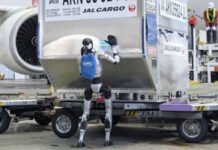
Humanoid robots have long captured public attention through online videos and technology demonstrations. While the machines often appeared impressive, large-scale commercial production remained largely out of reach.
That situation is beginning to change.
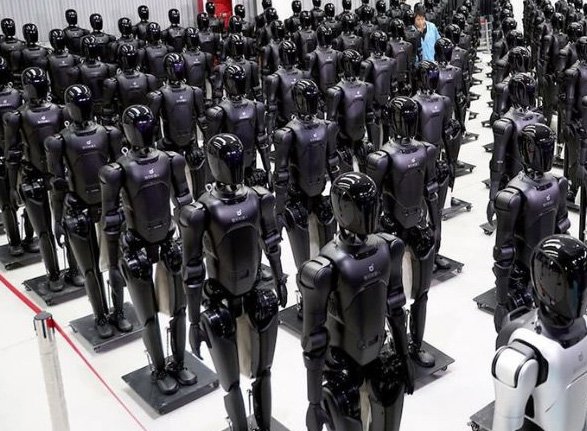
A newly established manufacturing facility in China is producing humanoid robots at a pace that resembles modern automotive assembly lines. The factory is capable of completing one robot every 30 minutes, highlighting how rapidly the industry is evolving beyond the experimental stage.
Factory Targets Annual Output of 10,000 Robots
The production facility was developed through a collaboration between Leju Robotics and Dongfang Precision Science & Technology.
With an estimated annual capacity of 10,000 units, the operation signals a significant shift from prototype development to industrial-scale manufacturing.
Rather than focusing on small batches, the companies have created a production system designed to support consistent, long-term output for commercial customers.
Quality Control Plays a Central Role
To improve reliability, the manufacturing process includes 24 specialized assembly stages and 77 separate inspection procedures.
Each robot undergoes extensive testing before leaving the production line. This approach addresses one of the biggest challenges facing humanoid robotics: ensuring machines can operate consistently in real-world environments.
The companies also report that the updated production model has increased manufacturing efficiency by more than 50 percent compared with previous methods.
Flexible Manufacturing Supports Multiple Industries
One of the facility’s key advantages is its ability to switch between different robot models without halting production.
This flexibility allows the factory to meet the needs of various sectors, including automotive manufacturing, consumer electronics, and household appliance industries.
As a result, humanoid robots are becoming more practical for businesses seeking scalable automation solutions.
Industry Focus Shifts From Innovation to Production
The robotics sector is entering a new stage of development.
In the past, companies primarily competed by demonstrating advanced robot capabilities. Today, investors and customers are paying closer attention to production capacity and deployment potential.
Manufacturers must now prove they can build robots efficiently and deliver them at scale.
Several companies have already taken steps in that direction:
Major Robotics Firms Expand Production Efforts
- Agibot has reportedly reached production of 10,000 units.
- Unitree Robotics is pursuing expansion plans supported by new investment.
- UBTECH Robotics is working toward reducing robot costs to below $20,000 per unit.
For investors, production volume has become an important indicator of a company’s ability to move beyond demonstrations and enter large-scale commercial markets.
Specialized Partnerships Could Accelerate Growth
Another notable trend within the industry is the division of responsibilities between companies.
In this partnership, Leju Robotics focuses on software development and robot design, while Dongfang Precision Science & Technology manages manufacturing operations and production scaling.
This structure mirrors strategies used in other technology industries, where one company develops the technology and another specializes in high-volume manufacturing.
Industry observers believe this model could help accelerate innovation and adoption throughout the robotics sector.
Software Remains the Biggest Challenge
Although hardware production continues to improve, software development remains a major obstacle.
Creating a physical robot is becoming increasingly achievable. Teaching that robot to function effectively in unpredictable real-world settings remains far more difficult.
Homes, warehouses, and public environments constantly change. Lighting conditions vary, objects differ in size and shape, and many routine human activities involve subtle decisions that are difficult for machines to replicate.
As factories increase output, attention is increasingly shifting toward artificial intelligence systems that enable robots to understand and respond to complex surroundings.
Growing Production Could Speed Up Adoption
As manufacturing scales up, production costs often decline.
Lower costs could make humanoid robots more accessible to businesses operating in logistics, retail, customer service, and other labor-intensive industries.
However, broader adoption is also expected to spark discussions about workplace transformation, safety standards, and public acceptance of human-like machines.
Humanoid Robots Move Closer to Mainstream Use
The debate surrounding humanoid robots is changing rapidly.
The industry is no longer focused solely on whether these machines can be built. The bigger question now is how quickly manufacturers can produce them and where they can deliver practical value.
With large-scale facilities beginning to emerge, companies across the robotics sector are entering a new race centered on production capacity, affordability, and real-world deployment.